Tuesday, September 4, 2012

Romancing the huts

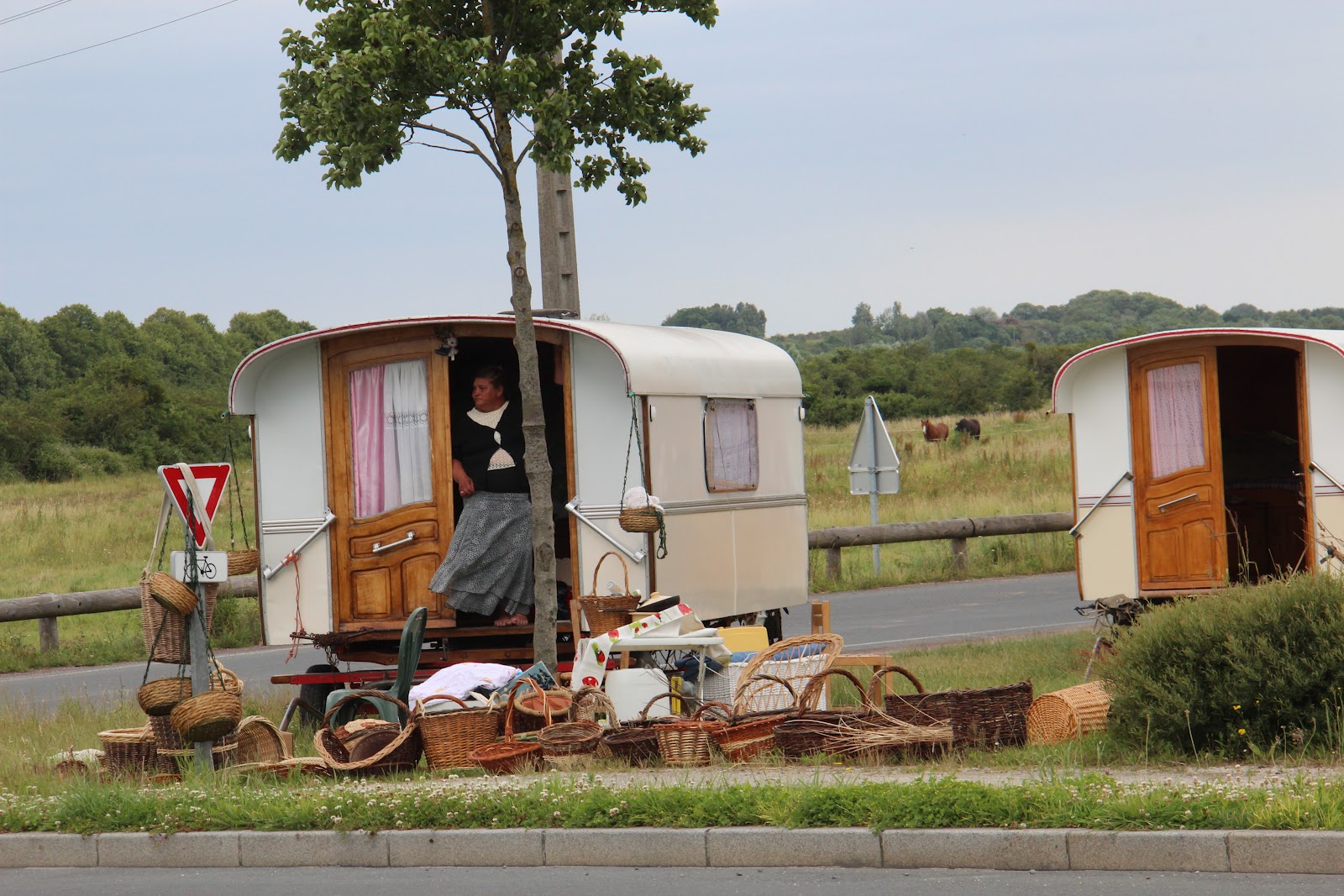
Still heading north we passed through Ranville where we spied a small group of Romani travellers camped near a crossing selling an assortment of home-made basketry.

Their caravans were as picturesque as Vincent made them in his masterpiece: Caravans, A gypsy camp near Arles.

From there to Trouville, where, despite the gloominess of this late summer colourful striped beach huts paraded along the strand, enticing the hardiest sand-dwellers into their shelter.

Cabanas and beach huts kept drawing our eye.

Little boxes, little boxes, little boxes all the same. And they're all made out of tick-tacky, but as charming as can be. 

There's a white one, and a blue one.

And a whole line of green and yellow ones, 

Lit by sunset, backed by blue clouds,

And while they're all made out of ticky tacky,

They are lovely, just the same.

And as the sun crept down in a blaze of light, people pinned by the views, picnic, watching. We found a restaurant with a view, lining up for three courses. This being the coast our choice was seafood. The first course: Potage de Poisson. Simply delicious!

The following day we found a variation on the beach huts at Berck plage: up and down that beach, cabanas were dipped in soft gelati colours: pink, blue, yellow and green. Even the high-rises facing the beach cabins were painted in sherbet. Looking at it felt just like eating fairy floss. 


Ranville Romanis


Caravans, a gypsy camp near Arles


Trouville beach huts


Cayeux-sur-mer cabanas from the esplanade


Pretty cabins


All in a row


Sunset on the beach at Cayeux-sur-mer


Potage de poisson


Lolly coated beach cabins at Berck


Monday, September 3, 2012

Monks and corsairs

Our time is up and we are leaving Brittany, desolate.  But we are avoiding England for the moment as the weather reports were all of sodden rain. We clung to the coast as we headed north from our home in Brittany. Again, England misses out on much of a summer. 

Passing the fishing traps of Tregastel we took our last shots of boat silhouettes on the Locquemeau waters and the mussel fisherman selling off his catch of the day from the deck of his boat. 

We stopped for a wonderful night at the picturesque town of Dinan, walking high on the ramparts overlooking the River Rance and the port. Then for hours up and down historic promenades filled with artillery towers, chateaux, gardens, churches and wealthy merchants homes dating back hundreds of years. 

We slept in an Aire on the Rance, not far from where the earliest inhabitants, a group of 9th century monks began their mission, while local lords set about building a wooden fortress that was to become the town. 

Then, as today, there would have been garden plots and walks backing on to the river; while further downstream the monks might have had little fishing carrelets at the end of rickety jettys, somewhat like the locals do now. The fragile wooden poles at the front carry the four corners of a large net which is lowered into the Rance when the fish are on the run. 

On to St Malo where from slits in the ramparts you can see the very sea where corsairs of long ago prospered as they plundered English ships that attempted to cross into these waters. These were pirates of some note, not your ordinary Johnny Depp, for they carried with them letters of royal permission, allowing them to go 'coursing' after enemy ships. 

Today eagles keep one eye on the watch. 

And as the tide rolls out, ancient wooden jetty poles stand testament to earlier times when the corsairs would moor their ships along these sandy shores of St Malo. 


Fishing pots


Locquemeau


Mussel fisherman on Sunday


View from Dinan ramparts


Dinan 


Half timbered merchant house


Gardens near our Aire 


Fishing carrelets on the Rance


View from the ramparts 


Eagle-eyed seagull 


St Malo relics washed by tides 


Friday, August 31, 2012

Long table Sunday lunch

Our stay in Brittany was enhanced by our spacious home exchange which was set, along with a pair of detached studio apartments also available for our use, in a couple of acres complete with a large swimming pool, BBQ cabana, vegetable plot, orchard and cider press. 

The living areas comfortably fitted our steady stream of visitors and the wonderful Lannion markets ensured our kitchen was always well stocked with locally prepared dishes of succulent pork cassoulet and paella, great chunks of meat from the rotisserie, not to mention giant slabs of confectioner's nougat for the sweet-toothed among us.

So the food for even everyday meals was memorable. 

But one long lunch at Mr and Mme Doyen's restaurant in a little nondescript building, barely identifiable as a restaurant, in the tiny village of Ploumilliou, was worth a standing ovation. 

Following the advice of our hosts we'd attempted to eat here several times previously, but were thwarted by mishaps in communication and timing. Finally we secured a booking. Understanding, only, that our meal was to involve "fruits du mer" we arrived at midday for Sunday lunch and sat down to a long table preset for our reservation of seven, already holding aloft two giant platters piled high with the freshest Brittany seafood available: crab, oysters, prawns, langoustines. 

This seafood feast took us, and everyone else in the restaurant who was fortunate enough to make a reservation for it, well over an hour to crack, pick and probe, and when, finally, we polished off the last morsel we fully expected to be handed our bill, and to head off home. 

We'd had elegant sufficiency. We were replete. We thought we had finished, in truth. 

Instead, another course was placed in front of each of us: a sublime skewer of fat white scallops, strips of smokey bacon and charred red peppers over a mound of fragrant rice, topped with champagne sauce, and slivers and squares of blanched vegetables as garnish. Too perfect not to touch. We all dug in, moaning with delight, but groaning that we, literally, had no room to spare. 

By now some of us had cottoned on that this was only the fish course, so, when a meat course inevitably arrived at our table, a jog around the restaurant block was never going to create enough room for it. Sadly most of us just looked at this delicious plate of perfectly cooked pork and mushrooms and wept. It looked sublime. It smelt sublime. We simply had no space. 

By now we were used to the Bretagne tradition of a madly generous cheese board served with beautifully dressed green salad leaves tangy with mustard, which typically follows the main course. When this arrived at our table some of us recalled the previous Sunday in another restaurant in another village, when a couple at a table beside us, finding they couldn't manage their cheeses, came prepared with plastic takeaway doggy bags and a large capacious purse. Those two are likely still eating their Sunday cheese selections. No doubt, superb. 

Finally, dessert. Not a wee slice, not a small dab of a little something sweet, but a mountain of a dessert, individually prepared, and presented as a choice among many: each sufficient as a meal in and of itself. Around four o'clock we settled into rich serves of dark coffee and a side of luscious chocolate, and in a state of stupefied satiation chatted with our fellow diners at La Doyen, one of whom happened to be celebrating his 96th birthday. So, in fine spirit, we amped up the Aussie noise, birthday wishes and kisses, ensuring the day remained memorable for him always. 

An amazing lunch. Made even more amazing given that we had no notion what was on offer, what was coming next, or even what it might cost in the end. As it panned out, even adding in four bottles of red and four of white, the bill, per person, barely pushed $AUD40, including the tip. 
Bravo, La Doyen! 


Our exchange home


The hub of the house


You could smell the pork crackle


Nougat the size of cheese wheels


Seafood platter


Scallops en brochette


Pork main


Cheese board and green tangy leaves


Sinful dessert


Thursday, August 30, 2012

Gibbets, dungeons and disillusion

One of the prettiest villages we visited in the western Finistere was Guerlesquin (gair-less-ken) which today is noteworthy as a petite cite de caractère and well deserves its classification.

Guerlesquin historic centre harks back to the ancient regime operating in France until it was overthrown by the French Revolution. The square held the functions of the manorial administration and justice was meted out on Mondays.

Offenders heading for the hereafter were promptly directed to the gibbet in the Place de la Liberte: off with their heads.

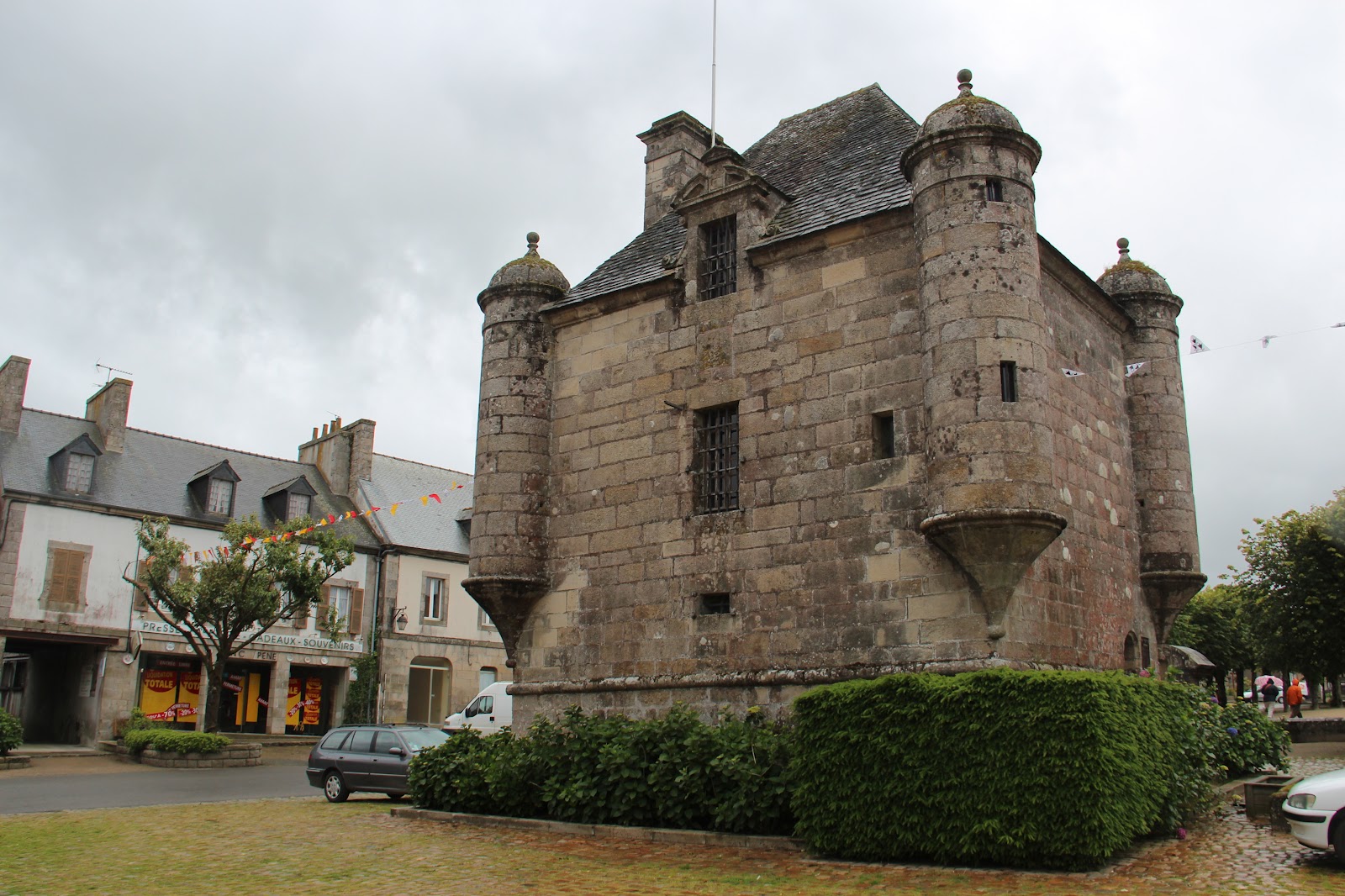
While offenders to be imprisoned were thrown into the icy dungeons in the dark basement of the Seigneuriale prison called the Presidial, built in the heart of the square in 1640 by the Lord of Guerlesquin, a commander of Richelieu's guards.

This prison, today, is a very pretty square fortress-like building with circular watchtowers, called bartizans, sited on each corner of the building. It was saved from destruction, classified as an historical monument, then set to function as the town hall as late as 1965.

There were market days aplenty in Guerlesquin, and the little granite town became famous far and wide for its horse fairs. A stone corn measure dating from 1539 is all that remains of the original market hall, this to measure local grains for taxes paid to the local seigneur. The hollowed-out measures were supposed to represent portions of a bushel, but the measuring stone came to be called Ar Men Gaou, the Liar Stone--as it measured too generously, of course, in favour of the tax collector.

Which was just another trigger, another of the disillusions, that lead to the revolution by the people, of the people. for the people.

Ninety lime trees were planted in the park called the Champ de Bataille, the Battlefield, and here, though no battles have ever been recorded, local lords were trained in the militia. Today, an old stone fountain of Saint Ener has been re-sited in the gardens of the park.

The church of St Tenenan replaced one to St Ener in the 16th century and its pretty bellower is all that remains of the original. Beams on the walls of the porch bear remarkable wooden statues of the twelve apostles, saved from the earlier chapel to St Ener.

An historic little village, Guerlesquin, filled with bits of history that have not yet been lost. 

Guerlesquin, petite cite de caractère


Seigneurial prison, Guerlesquin


Ar Men Gaou, the Liar Stone, corn measure


Lime trees all in a row


Saint Ener fountain


Wooden statues of the Twelve Apostles 


Tuesday, July 24, 2012

Pink granite coast

Three hundred million years ago when the earth rumbled and magma flowed, hot matter bubbled up from the bowels of the earth and lay itself down to cool along the coast of Brittany. The rock that formed from that event is the loveliest pink granite, found only in a couple of places on earth. Feldspar, I think, might give it its colour. Here, the pink granite is reputed to still reach down to a depth of 5 or 6 kilometres, so, even though it is being used up rapidly, there seems to be enough of it that it is likely to be around for a long long time. 

Time and tides and tumbling are slowly eroding the surface of the granite until, today, there are patches of pink to be found all along a 20 kilometre stretch of the Brittany coast close to our summer home, from huge cartoon-style menhir-like boulders of soft pink granite, down to smaller pebbles of it on the beaches, to fine grains of pink sand permeating the bays and the waterways. This stretch of coast is named after it: la cote de granit rose, or the pink granite coast.

One of the most unusual sights along the pink granite coast as, oddly, it has its back to the sea, is the Pointe du Chateau, or Castel Meur. This is a home, built as close to the water as a building can get, but facing inland to a lagoon. It looks as though it has grown organically out of two rocks, or been caught and trapped tightly between them. A house on the edge: it appears strong and immovable, yet the tenacious sea is just a few creeping metres away. Time and tides.

Further along there an exclusive little village with a tastefully expensive hotel that has an exotic tree planted in its garden at Plage St-Guirec. 

Beyond the tree, and a little way along the sandy pink plage is a tiny rock Oratory dedicated to Saint Guirec, one of the mystical monks of Brittany who sailed across from Wales in order to start his monastery here in the 6th century. A little like Pol. So beloved was Guirec that by the 12th century a shrine was built here in his honour and it is maintained even today. Young women, seeking to get married, or pregnant, would make a pilgrimage to this spot and tweak Guirec's stone nose, demanding his intercession and prayers. Saint Guirec's nose has now completely worn away. Poor Guirec. Such are the trials of sainthood.

Over the point and down onto Tregastel Plage the granite rocks are giant, even theme-park in their monstrosity. 

A stunning statue in the local church is tinged pink.

Children over the decades have found names for the odd rock shapes along the coast: the pile of crepes, the skull, the great chasm, and the dice.

Even the summer beach cafe is decorated to maximise the pink theme.

While yellow buoys and blue seas come together on pink sands.


Eiffel House, Ploumanach


Perros Guirec - north of Trestraou beach, pink granite


Pointe de L'Arcouest-  white rock, pink beach


Castel Meur, Plougrescant


Hotel tree, Ploumanach


Oratory of St Guirec, Ploumanach


Pink rocks at Tregastel place


Tregastel church


Theme park rocks at Tregastel Plage


Tregastel - Plage Beach cafe


Primal - Tregastel buoys

Sunday, July 15, 2012

Relics and miracles

On the feast of St John the Baptist, we were extraordinarily lucky to see a Pardon taking place in the village of St John du Doigt, just a stone's throw from our summer home. 

A 'Pardon' in Brittany, is a bit like a grand confession, followed by an even grander procession. And today, as in the Middle Ages, these are the biggest religious festivals of the year. Pilgrims gather from early morning till the last prayer is uttered, praying long and hard for indulgences to be granted by the saint whose feast it is.

This village takes its name from the saint's relic kept in the parish church. This particular relic in this particular village is the right index finger of St John the Baptist. Voila, the village is called St Jean's finger, or St Jean du Doigt. 

Mind you, this is not the only church in the world claiming to have the right index finger of St John the Baptist as its church relic. There are others. Nonetheless, the Pardon continues in this village, year after year, regardless of this anomaly.

St Jean's finger came to this village quite miraculously. Actually, many of the stories to do with this finger abound in miracles. 

After devoting his prayers to St Jean's finger almost to the point of exclusivity, a young medieval knight returned home to France after his crusade only to find as he neared his destination that the object of his adoration had miraculously attached itself to his person, lodging beneath his wrist cloths.  

Not a finger of blame was thought to be apportioned. This was immediately deemed a miracle. 

The finger relic found a home. Pilgrims came, miracles happened, its fame spread like wildfire. And over time, the finger became famous far and wide for healing eye afflictions. 

The English, at the time of Henry V11, even attempted to steal the famous finger, only to have it time and again be found returned to its niche in the village church. Unmoved and unmovable. 

Anne de Bretagne, hearing of its amazing powers, sent for the finger to heal an eye problem she was having. Her henchmen, though, were thwarted every time they attempted to move it further than the church door. From there, it simply flew from their grasp, returning itself back to its rightful abode. 

Duchess Anne quickly deduced from this that if she wished to be healed she would need to be the one to make the move. This she did, taking herself on a pilgrimage to St Jean du Doigt, and, on finding a cure thanks to the finger, showered many gifts on the church and its parish in gratitude. 

St Jean du Doigt's Pardon is a Pardon of Fire. After mass, hymns and prayers, the pilgrims and participants gather high on the hill overlooking the village on one side and the bay on the other. Here, they light a massive bonfire that acts like a beacon far out to sea. These last few years we have seen St Jean feast day bonfires on hills as far south as Portugal. 

A procession follows, winding down to the pretty enclos paroissial in the valley below. Followers carry gilded crosses and colourful banners with decorative insignia. Taking pride of place in the middle of the cluster is the relic of St Jean's finger in its precious glass casket. 

Several of the stronger members of the crowd carry a large ship, accompanied by heartfelt prayers seeking to avoid shipwrecks along this dangerous coast. Statues, candles, smaller relics and other intercessions follow step by step down the hill to the church. Many of the celebrants are wearing traditional Breton festival gear. There are ladies in lovely lace bonnets aplenty. 

Inside the church as the followers congregate, a queue forms down the aisle of the nave ready to receive the very special blessing so many have specifically come for. A priest carefully takes the ancient relic of St Jean from its place of repose and gently touches it to the eye of each pilgrim needing relief. He stays, offering the cure, as long as his blessing is needed. On, into the night, if necessary.

Outside, after the Pardon, the village streets, inn and bar are beginning to fill with those who have a reason to celebrate. The night is still young when we head for home. 

Contemplating: that this has been happening in this village for over 600 years. Year after year after year.

Pardon of Fire


St Jean's finger relic in glass casket


Processing a ship accompanied by prayers to avoid shipwrecks


L'eglise de St Jean du Doigt


L'eglise de St Jean du Doigt


Gentle touch to relieve each pilgrim